Category: Software

  • How Credentialing Works in Healthcare Organizations

    How Credentialing Works in Healthcare Organizations

    What is credentialing in healthcare?

    Credentialing rarely gets much attention until something slows down.

    A physician is hired. A nurse practitioner signs the offer. Leadership wants clinic access open next week. Then one missing verification, one old address on a form, or one unanswered request from a training program throws sand in the gears. Schedules shift. Revenue waits. Operations teams start emailing each other with a tone nobody enjoys.

    Most healthcare companies know this cycle.

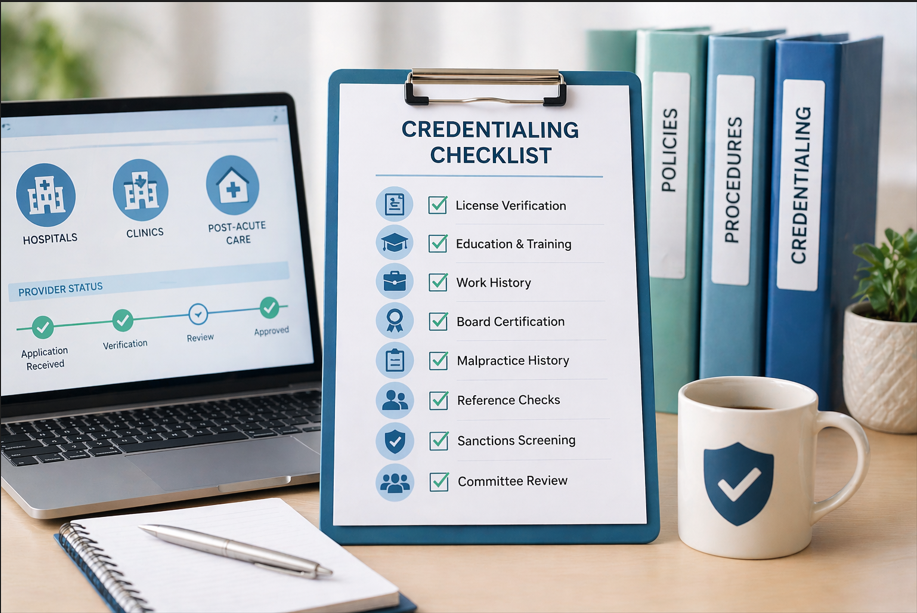
    Credentialing is the process healthcare organizations use to confirm a clinician’s qualifications before that person begins practice in a role. At a basic level, it means checking education, licensure, training, work history, board status, malpractice history, sanctions, and other professional records. The goal is simple: confirm the person in front of you has the background required for safe care and lawful practice inside the organization.

    People often put credentialing together with enrollment and privileging. Those terms sit close to each other, though they do different jobs. Credentialing checks qualifications. Enrollment connects a provider to payer participation and billing access. Privileging decides which clinical services a provider may perform inside a facility.

    How does the credentialing process work?

    The basic workflow usually starts with an application. A provider submits personal details, training history, licenses, certifications, work history, references, disclosure forms, and supporting documents. On paper, that sounds straightforward. In practice, the first pass often turns up gaps. A date range may not line up, or a previous employer is missing. Maybe a license copy has expired. Someone forgot to explain six months out of practice ten years ago, and now a credentialing specialist has to track it down on a Thursday afternoon.

    From there, the organization begins verification. Staff confirm state licenses, check board certification, verify education and training, review professional references, screen for exclusions or sanctions, and look at malpractice claims history where applicable. Many organizations use primary source verification for key items, which means they go back to the original issuing body or a trusted source rather than relying on a photocopy someone uploaded.

    After verification, the file often moves through an internal review. In a hospital, this may involve a medical staff office, department leaders, and a credentialing committee. In a physician group or outpatient setting, the structure may look leaner, though somebody still has to review the file and approve the provider for work. Facilities with formal privileging processes add another layer. A surgeon, therapist, physician assistant, or advanced practice provider may qualify for some duties and need separate review for others.

    Where do credentialing delays happen?

    Credentialing problems rarely show up as one giant disaster. They usually arrive as a pile of smaller issues.

    Incomplete applications are common. Inconsistent provider data across HR systems, payer files, and internal records can create hours of cleanup. Committee meetings may happen only on certain dates, so even a complete file can wait in line. A provider may get internal approval and still need payer enrollment work before the organization can bill. That catches a lot of groups off guard, especially fast-growing practices that want new hires productive right away.

    Hospitals tend to build more formal structures around credentialing because the clinical risk is broad and the staffing model is complex. Clinics and ambulatory groups often focus on speed because provider access and payer readiness hit revenue almost immediately. Post-acute organizations face their own version of the same problem. Teams are often smaller. Administrative bandwidth can run thin. One missing piece of documentation can eat up a surprising chunk of the week.

    Why does credentialing matter so much?

    Credentialing reaches far beyond the medical staff office or HR desk.

    A delayed credentialing file can postpone a start date. It can reduce appointment availability. It can leave a unit short on coverage. It can hold up billing for weeks after a provider has already begun work under a temporary arrangement. Patients do not usually hear the word “credentialing” when an appointment gets moved, though they still live with the result.

    There is also a patient safety side to this. Credentialing helps healthcare organizations confirm that the people delivering care have the education, licensure, and history required for the role. A clean credentialing system reduces the chance of preventable errors tied to incomplete vetting, scope confusion, or expired qualifications.

    The work does not end once a provider gets approved, either. Recredentialing and ongoing monitoring keep the file alive. Licenses expire. Certifications need renewal. Sanctions databases change. A provider who looked fully clear at hire may need follow-up later.

    For healthcare organizations, credentialing works best when leadership sees it as core infrastructure. It affects hiring speed, clinical access, reimbursement, compliance, and patient trust. It can look like background admin work from a distance. Up close, it shapes who can practice, when they can start, what they can do, and how smoothly the business runs around them.

    So yes, credentialing can be tedious. It can be slow. It can also save a healthcare company from avoidable chaos. In this area of healthcare, boring usually beats dramatic, and a well-run credentialing process is about as boring as it gets. And that is a compliment.

  • What Is Healthcare Compliance Training and Why Does It Matter?

    What Is Healthcare Compliance Training and Why Does It Matter?

    Early in my career, compliance training felt like one more item jammed into an already crowded week. You finish rounds, answer messages, sign charts, then a reminder pops up about privacy training or workplace conduct. Most physicians know the routine. You click through slides, answer a few quiz questions, and get back to the part of the job people actually trained for.

    After enough years in practice, my view changed.

    I saw a chart left open on a shared workstation. I saw a rushed conversation about a patient take place in a hallway with more foot traffic than anyone noticed at first. I saw documentation choices create confusion for the next clinician who picked up the case. None of those moments looked dramatic in real time. Still, each one carried risk. That is where compliance training starts to make more sense. It gives people a common playbook for handling the small decisions that shape care every day.

    In plain terms, healthcare compliance training teaches staff the rules, policies, and professional expectations tied to safe and lawful care. Some topics come up almost everywhere: HIPAA, patient privacy, workplace safety, billing practices, incident reporting, harassment prevention, infection control, documentation standards. A physician may sit through one version. A front desk employee may get another. A nurse manager may need extra training tied to supervision or reporting duties. The core idea stays simple enough: people need to know what the organization expects, what the law requires, and what can go wrong when those two pieces get ignored.

    That sounds obvious. In real life, plenty of teams work under pressure, and pressure has a way of exposing every weak habit in a system.

    A patient asks for test results while family members stand nearby. A medical assistant relays information over the phone and skips one identity check because the office runs behind. A resident copies a note forward and leaves language in the chart that no longer fits the patient in front of them. These are not rare scenes. They are ordinary healthcare scenes. Compliance training exists for those moments more than it exists for the annual audit binder sitting on a shelf somewhere.

    People outside healthcare sometimes assume compliance is mostly about avoiding fines. Fines are part of the picture, sure. The daily effect lands closer to patient safety, communication, trust, and consistency. When staff understand privacy rules, reporting procedures, and documentation expectations, the work tends to run cleaner. Not perfect. Cleaner. Patients notice that too, even if they never use the word “compliance.”

    The problem, and physicians say this pretty openly, is that a lot of compliance training feels disconnected from real care. Some modules drag on forever. Some use canned examples that sound like they were written by someone who has never stepped onto a hospital floor at 6:15 on a Monday morning. Some bury practical guidance under thick legal language, then act surprised when staff rush through it. That frustration is real. I have felt it myself, more than once.

    Good compliance training looks different.

    It uses examples people recognize. It respects the fact that clinicians think in cases, patterns, and consequences. It explains why a rule exists instead of waving a policy around like a traffic ticket. It also leaves room for the gray areas. Healthcare has plenty of gray areas. You can write a policy for voicemail messages, secure texting, delegation, and reporting lines, then a real patient scenario walks in and everyone has to pause for a second. Solid training helps people make better calls in those moments.

    I have also seen compliance training work well in places where leadership treated it as part of patient care rather than a separate administrative nuisance. In those settings, questions were welcome. Staff could raise concerns without getting brushed off. Managers reinforced the lessons during normal work instead of once a year during module season. That approach changes the tone. People stop seeing training as a hoop to jump through and start seeing it as part of how the team functions.

    For physicians, the value often shows up in documentation and communication. A well-trained team charts more clearly, reports concerns earlier, and handles patient information with more care. Those habits support everyone around them. The next doctor who opens the chart has a better shot at understanding what happened. The nurse calling with an update has cleaner information. The billing team has fewer loose ends. The compliance officer gets fewer ugly surprises three months later, which I suspect helps their blood pressure.

    There is a cultural side to this too. Compliance training tells staff what kind of workplace they are in. It sets expectations for conduct, boundaries, speaking up, and handling mistakes. In a healthy environment, those lessons do not live only inside a learning platform. You hear them in how managers respond to incidents, how peers correct one another, and how seriously the organization takes concerns from people lower on the ladder. Staff notice fast when the training says one thing and daily behavior says another. They notice very, very fast.

    One reason this topic keeps coming up is simple: healthcare relies on human beings, and human beings get tired, distracted, rushed, irritated, overconfident, hungry, and sometimes all six before noon. Compliance training cannot fix every bad day. It can reduce confusion. It can help people slow down in the right moments. It can give new employees a better start and older employees a useful reset, even the stubborn ones who think they already know every rule in the building.

    As a physician, I do not see compliance training as the most glamorous part of healthcare. Nobody went to medical school dreaming about online modules and annual attestations. Still, the strongest training programs connect policy to real patient care. They help teams protect privacy, document accurately, report concerns early, and avoid preventable harm. Those are practical goals. They shape the work in quiet ways, day after day.

    So yes, compliance training can feel repetitive. Some versions deserve the eye roll they get. The answer is better training, clearer examples, and stronger reinforcement in daily practice. In a busy clinic, hospital, or post-acute setting, the small habits often decide whether a team runs smoothly or spends the afternoon cleaning up preventable mistakes. Compliance training speaks to those habits. That is why it keeps earning a place in healthcare, even when nobody is excited to open the module.

  • What Does a Workforce Management Platform Do…Exactly?

    What Does a Workforce Management Platform Do…Exactly?

    Healthcare organizations run on people. Nurses, physicians, technicians, administrative staff, support teams. Every shift must be covered. Every credential must stay current. Every hour must be tracked accurately. Labor often represents the largest operational expense in healthcare.

    A workforce management platform exists to bring structure, visibility, and control to all of that.

    Here is what it actually does.


    1. It Builds and Manages Staff Schedules

    Scheduling in healthcare is complex. Facilities operate around the clock. Patient volume fluctuates. Skill requirements vary by unit. Overtime rules differ by role and location.

    A workforce management platform centralizes scheduling by:

    • Creating shift templates
    • Matching staff skills to coverage needs
    • Tracking full-time, part-time, per diem, and float staff
    • Preventing double-booking
    • Flagging overtime before it happens
    • Allowing managers to adjust schedules in real time

    It replaces manual spreadsheets and fragmented systems with one structured scheduling environment.

    The result is clearer coverage planning and fewer last-minute gaps.


    2. It Tracks Time and Attendance

    Accurate time tracking is essential in healthcare. Payroll errors affect morale. Compliance errors can create legal exposure.

    A workforce management system tracks:

    • Clock-ins and clock-outs
    • Breaks and meal periods
    • Shift differentials
    • On-call hours
    • Overtime accumulation
    • PTO usage

    Many platforms integrate with badge systems, mobile check-ins, or biometric verification. Managers can monitor attendance patterns, approve timecards, and correct discrepancies before payroll is processed.

    This creates a clean audit trail for both payroll and compliance purposes.


    3. It Helps Control Labor Costs

    Labor is often the largest controllable expense in a healthcare organization.

    A workforce management platform provides:

    • Real-time labor cost visibility
    • Forecasting based on historical demand
    • Overtime tracking
    • Agency and contract labor monitoring
    • Budget comparisons by department

    Instead of reacting to payroll reports after the fact, leaders can see cost trends as they develop. That visibility allows proactive adjustments in staffing levels or shift allocation.

    Cost control becomes data-driven rather than reactive.


    4. It Supports Compliance and Credential Management

    Healthcare staffing must meet regulatory and accreditation requirements. Skill mix rules. Licensing standards. Certification expiration dates. Labor law constraints.

    A workforce management platform can:

    • Track licenses and certifications
    • Alert managers before credentials expire
    • Enforce skill-based scheduling rules
    • Maintain documentation for audits
    • Apply labor law requirements automatically

    This reduces the risk of assigning underqualified staff or violating workforce regulations.

    Compliance becomes embedded in the scheduling process rather than managed separately.


    5. It Improves Staffing Forecasting

    Patient demand is not static. Seasonal illness trends, elective procedure volumes, and census fluctuations all impact staffing needs.

    Workforce management systems use historical data to:

    • Predict peak demand periods
    • Model staffing scenarios
    • Identify under- or over-staffed shifts
    • Align staffing levels with patient volume trends

    Forecasting tools support more stable staffing decisions. That helps reduce burnout and prevent excessive overtime.


    6. It Enables Self-Service for Employees

    Modern workforce platforms often include employee-facing features.

    Staff can:

    • View schedules
    • Request time off
    • Swap shifts
    • Pick up open shifts
    • Track hours worked
    • Receive notifications

    This reduces administrative workload for managers. It also increases transparency for staff.

    A structured shift exchange process reduces informal messaging chains and scheduling confusion.


    7. It Centralizes Workforce Data

    Healthcare organizations often operate across multiple departments or locations. Data can become fragmented.

    A workforce management platform consolidates:

    • Staffing levels by unit
    • Overtime trends
    • Attendance patterns
    • Labor cost reports
    • Productivity metrics

    Centralized reporting gives leadership a single source of truth. Patterns become visible across departments. Strategic decisions can be based on accurate workforce data.


    8. It Connects with Other Systems

    Workforce management does not operate in isolation. It often integrates with:

    • Payroll systems
    • Human resources platforms
    • Electronic health record systems
    • Financial reporting tools

    Integration reduces duplicate data entry and minimizes errors.

    When systems communicate, updates flow automatically between departments.


    9. It Supports Operational Agility

    Healthcare environments shift quickly. A sudden increase in admissions. Staff illness. Regulatory changes.

    A workforce management platform provides real-time visibility and quick adjustment capabilities. Managers can identify open shifts immediately. Notifications can go out to qualified staff. Staffing levels can be recalibrated without rebuilding schedules from scratch.

    That flexibility supports continuity of care.


    10. It Creates Accountability and Transparency

    Without centralized systems, workforce processes rely heavily on manual oversight. That can lead to inconsistencies.

    A structured platform introduces:

    • Clear approval workflows
    • Documented schedule changes
    • Transparent timecard edits
    • Measurable labor KPIs

    Accountability becomes measurable rather than assumed.


    The Bigger Picture

    A workforce management platform is not just scheduling software.

    It is a coordination system for labor planning, compliance oversight, cost control, and operational visibility.

    In healthcare, staffing directly affects patient care, staff well-being, and financial performance. A workforce management platform helps align those moving parts under one digital framework.

    At its core, it answers a simple question:

    Do we have the right people, with the right skills, in the right place, at the right time — and can we prove it?

    That clarity is what healthcare organizations rely on to keep operations steady and sustainable.

  • Welcome to HealthcareCompanyReviews.Com

    Welcome to HealthcareCompanyReviews.Com

    I want to clear something up right away. HealthcareCompanyReviews.Com exists to serve clinicians, administrators, executives, and patients who need honest insight into the healthcare industry. My years as a nurse at Cedars Sinai shaped that mission. I saw how one software glitch could slow a shift to a crawl. I saw how a staffing gap could ripple through an entire unit. Those experiences guide every review we publish.

    We test healthcare SaaS platforms in structured, repeatable environments that mirror clinical and administrative workflows. Our team requests full demos, sandbox access, and documentation before a single word goes live on the site. We evaluate electronic health record tools, revenue cycle systems, telehealth platforms, compliance dashboards, and analytics suites. We measure load times, permission controls, audit trails, reporting depth, and customer support response. We speak with current users across roles, from bedside nurses to chief information officers. We document friction points and real strengths. Vendors do not see drafts before publication. Scores come from predefined criteria, not from marketing promises. That is how trust gets built, plain and simple.

    Workforce platform management systems receive an equally detailed review. Staffing software can shape morale, retention, and patient safety. We analyze credential tracking, shift bidding logic, overtime controls, payroll integration, and alert systems. We test mobile access under real shift conditions. We check how quickly a manager can fill an open shift. We review how transparent the algorithm feels to staff. If a tool claims to reduce burnout, we look for measurable outcomes and real testimonials from clinical teams.

    Our reviews extend to individual provider groups and full healthcare systems such as hospitals and regional networks. Publicly available quality data informs our scoring. Patient satisfaction surveys matter. Community reputation counts. We examine safety grades, specialty coverage, wait times, and access for underserved populations. I rely on my clinical background to assess whether policies make sense on a hospital floor at three in the morning. A polished mission statement means very little if frontline staff struggle to execute it.

    Unbiased reporting requires structure. We maintain written editorial standards, a transparent scoring rubric, and strict disclosure policies. Vendors cannot purchase placement or higher ratings. Sponsored content appears only with clear labeling. Every claim in a review links back to verified documentation, interviews, or data sources. Readers deserve clarity, not smoke and mirrors. Healthcare decisions carry weight. Careers, budgets, and patient outcomes sit on the line.

    HealthcareCompanyReviews.Com also provides a comprehensive glossary for industry professionals. Healthcare language can overwhelm even seasoned staff. Terms such as capitation, prior authorization, interoperability, and value based reimbursement appear daily in meetings and contracts. Our glossary translates complex policy and technology language into direct, readable definitions. New administrators gain confidence. Experienced clinicians find quick reference points. Tech founders entering healthcare gain context that saves time and frustration.

    At the end of the day, HealthcareCompanyReviews.Com stands on one principle. People deserve the truth. My background as a nurse keeps that promise grounded in real experience. Every review, every score, every glossary entry serves one goal, clear and reliable insight for a complex industry.


    About Heather Mullens

    Heather Mullens is a former nurse at Cedars Sinai who spent years delivering direct patient care in acute hospital settings. Her clinical experience informs her leadership at HealthcareCompanyReviews.Com, where she oversees research standards, scoring methodology, and editorial integrity. Heather brings frontline perspective, practical judgment, and a deep respect for patient safety to every review published on the site.